
DEA Storage
Requirements
A comprehensive guide to controlled substance storage requirements under 21 CFR 1301.72–1301.76. Understand which safes and vaults the DEA requires for your facility — and how to pass inspection.
What the Law Requires
The Drug Enforcement Administration (DEA) mandates that all registrants — pharmacies, hospitals, clinics, research facilities, manufacturers, and distributors — store controlled substances in secure, DEA-compliant containers. The specific requirements are outlined in Title 21, Code of Federal Regulations (CFR), Sections 1301.71 through 1301.76.
The storage requirements are tiered by drug schedule. Schedule I and II substances (the highest potential for abuse) demand the most rigorous physical security, while Schedule III through V allow progressively more flexible options.
Physical Security — Non-Practitioners
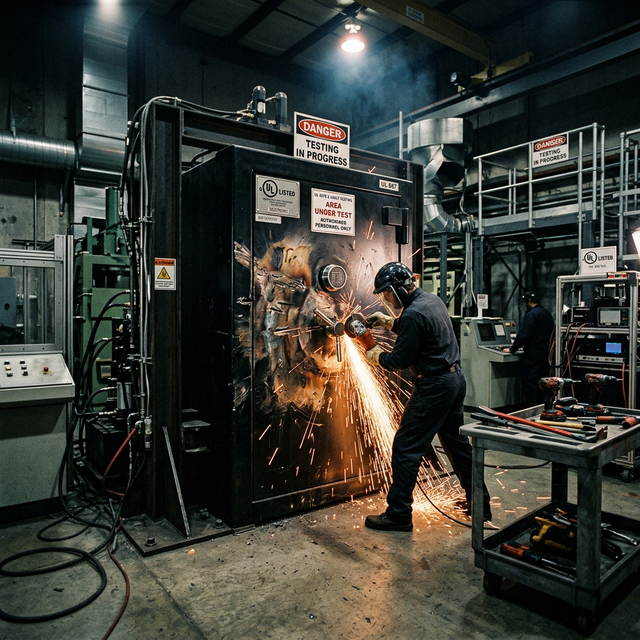
Requirements for manufacturers, distributors, and researchers. Mandates GSA Class 5 containers or UL TL-15+ safes with Group 1-R locks for Schedule I & II.
Physical Security — Practitioners
Requirements for pharmacies, hospitals, and physicians. Requires "securely locked, substantially constructed" cabinets. Pharmacies may disperse stock to obscure location.
Other Security Controls
Employee screening, access limitation, visitor supervision, and the 750-lb anchoring mandate. Requires combination changes upon employee termination.
Compliance Matters
Non-compliance can result in loss of DEA registration, civil penalties, and criminal prosecution
Storage Requirements
Oxycodone, Fentanyl, Morphine, Adderall, Ritalin
GSA Class 5 security container OR UL-listed TL-15+ safe with Group 1-R lock
Must be bolted/cemented if under 750 lbs
Minimum authorized personnel only; alarm required
Tylenol with Codeine, Ketamine, Testosterone
Securely locked, substantially constructed cabinet — OR — dispersed throughout non-controlled stock (pharmacies only)
Perimeter security with self-closing, self-locking doors
Electronic alarm system required; limited access
Xanax, Valium, Ambien, Tramadol
Securely locked, substantially constructed cabinet or dispersed stock
Self-closing, self-locking access points
Security cage (No. 10 gauge steel) or alarm system
Cough preparations with codeine, Pregabalin
Securely locked, substantially constructed cabinet or dispersed stock
Building perimeter security
Controlled access with secure locking devices
Approved Safe & Vault Specifications
The DEA recognizes two primary safe standards for Schedule I and II controlled substance storage. Both must be paired with appropriate lock and alarm systems.
Government Security Container
- 30 minutes covert/surreptitious entry resistance
- 10 minutes forced entry resistance
- 20 hours lock manipulation & radiological attack resistance
- Required for carfentanil, etorphine, diprenorphine
Burglary Resistant Safe
- Exceeds 10-minute forced entry requirement
- Must include Group 1-R combination lock for Schedule I & II compliance
- Bolt down required if safe weighs under 750 lbs
- Alarm system transmitting to central station or police required
Vault Construction Requirements
For manufacturers and distributors storing bulk Schedule I & II substances
8" reinforced concrete minimum (or structural equivalent)
Self-closing, self-locking day-gate plus vault door
Contact switches, electrical lacing, or ultrasonic detection
UL-listed modular vault panels (structural equivalent)
Common DEA Violations
DEA inspectors focus heavily on storage compliance. These are the most frequently cited violations — avoid them to maintain your registration and protect your practice.
Incomplete Record-Keeping
Missing DEA Form 222s, unrecorded transactions, or failure to separate Schedule I–II records from Schedule III–V records.
Improper Safe Specifications
Using safes without UL TL-15 rating, missing Group 1-R lock, or failing to bolt down safes under 750 lbs.
Inadequate Access Control
Leaving substances unattended, failing to limit access, or not changing combinations when staff departs.
Failure to Report Losses
Not reporting thefts or significant losses to the DEA within one business day via DEA Form 106.
Employee Screening Failures
Granting controlled substance access to individuals with drug-related felonies or prior DEA registration revocations.
Need a DEA-Compliant Safe?
Our team specializes in DEA-compliant safe and vault installations for pharmacies, hospitals, veterinary clinics, and research facilities. We'll ensure your storage meets every federal and state requirement.