
Insurance Requirements
for Commercial Safes
Your safe's UL rating directly determines your insurance coverage limits. Learn what your carrier requires, how safe ratings affect premiums, and what happens when you file a claim without the right safe.
Your Safe Rating = Your Coverage Limit
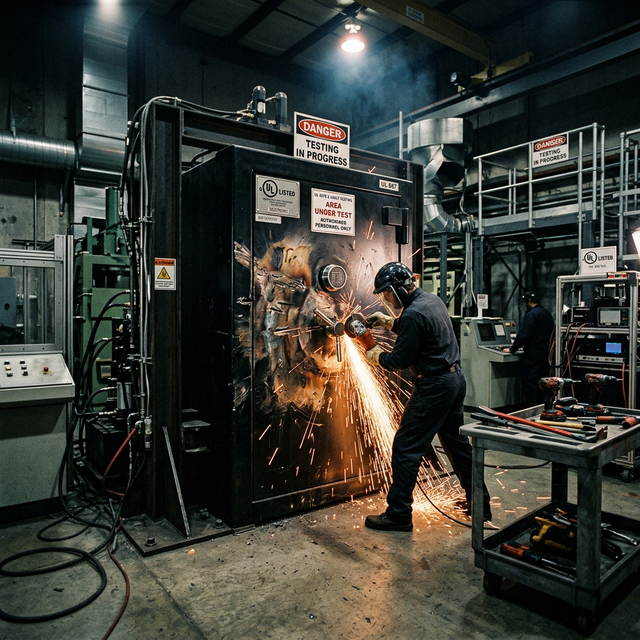
Most business owners don't realize that their commercial insurance policy directly ties coverage limits to the UL rating of their safe. A TL-15 safe and a TRTL-30x6 safe don't just offer different levels of physical protection — they determine whether your insurer will cover $100,000 or $4.5 million in losses.
Key carriers like Jewelers Mutual, Chubb, AXA XL, Berkley Asset Protection, Lloyd's of London, and Travelers all mandate specific safe ratings as part of their "Security Warranty" conditions. Fail to meet them, and your claim gets denied.
A monitored alarm can double your safe's insurable limit
Jewelers Mutual requires bolt-down for any safe under 500 lbs
Claim denial rate when Security Warranty requirements aren't met
Insurable Limits by Safe Rating
Each UL safe rating corresponds to a maximum insurable value. Adding a monitored alarm system can significantly increase these limits.
Tool Resistant — 15 Minutes
$100K – $150K
$200K – $300K
- Small retail
- Professional offices
- Light commercial
Tool Resistant — 30 Minutes
$195K – $350K
$375K – $700K
- Jewelry retail
- Pharmacies
- Gun dealers
Tool Resistant — 30 Min, All 6 Sides
$275K – $750K
$500K – $1.5M
- High-end jewelry
- Banking
- Pharmaceutical
Torch & Tool — 30 Min, All 6 Sides
$1M – $4.5M
$2M – $9M
- Jewelry wholesale
- Diamond vaults
- Banking vaults
Torch & Tool — 60 Min, All 6 Sides
$4.5M+
$9M+
- Gem wholesalers
- Federal facilities
- Maximum security
Industry-Specific Requirements
Jewelry Stores
Carriers: Jewelers Mutual, Chubb, AXA XL, Berkley, Lloyd's
TL-15 minimum; TL-30x6 or higher for high-value retail
Safes under 500 lbs must be bolted to the floor (Jewelers Mutual mandate).
All merchandise must be locked in the safe when store is closed — items left in display cases overnight are generally NOT covered.
Fire protection rating (1–2 hour) also required. Jewelers Block policy includes strict Security Warranties.
Pharmacies & Healthcare
Carriers: DEA-mandated (applies to all insurance carriers)
UL TL-30 with Group 1-R lock for Schedule I & II drugs
Mandatory bolt-down or cementation for safes under 750 lbs per DEA 21 CFR 1301.72.
Safe must weigh at least 750 lbs OR be bolted to floor/wall. Digital locks alone do not meet Group 1-R standard.
Schedule III–V can use substantially constructed cabinets with perimeter alarms and limited access.
Banks & Credit Unions
Carriers: FDIC/OCC regulated — applies to all banking insurers
TL-30x6 or TRTL-30x6 minimum for depository institutions
Vault construction mandated — not applicable (permanently built structure).
Federal vault construction standards (Class M/C) apply. Vault doors must meet specific blast and attack resistance ratings.
Cash handling insurance requires documented vault procedures and dual-control access. Alarm monitoring is mandatory.
Critical Factor
A monitored alarm can double your safe's insurable limit — from $195K to $375K+ on a TL-30
Continue Learning
Safe Rating Guide
Understand UL ratings: TL-15 through TRTL-60x6 — what they test and which you need.
Read Guide →DEA Storage Compliance
Federal requirements for controlled substance storage under 21 CFR 1301.72.
Read Guide →Cannabis Vault Compliance
NJ and NY dispensary vault requirements, security plans, and compliance standards.
Read Guide →Not Sure Which Rating You Need?
We work directly with insurance carriers and can help you match the right safe rating to your policy requirements. Stop overpaying for coverage you can't use, or worse — filing a claim with a safe that doesn't meet your Security Warranty.